Building the Data Foundation for AI
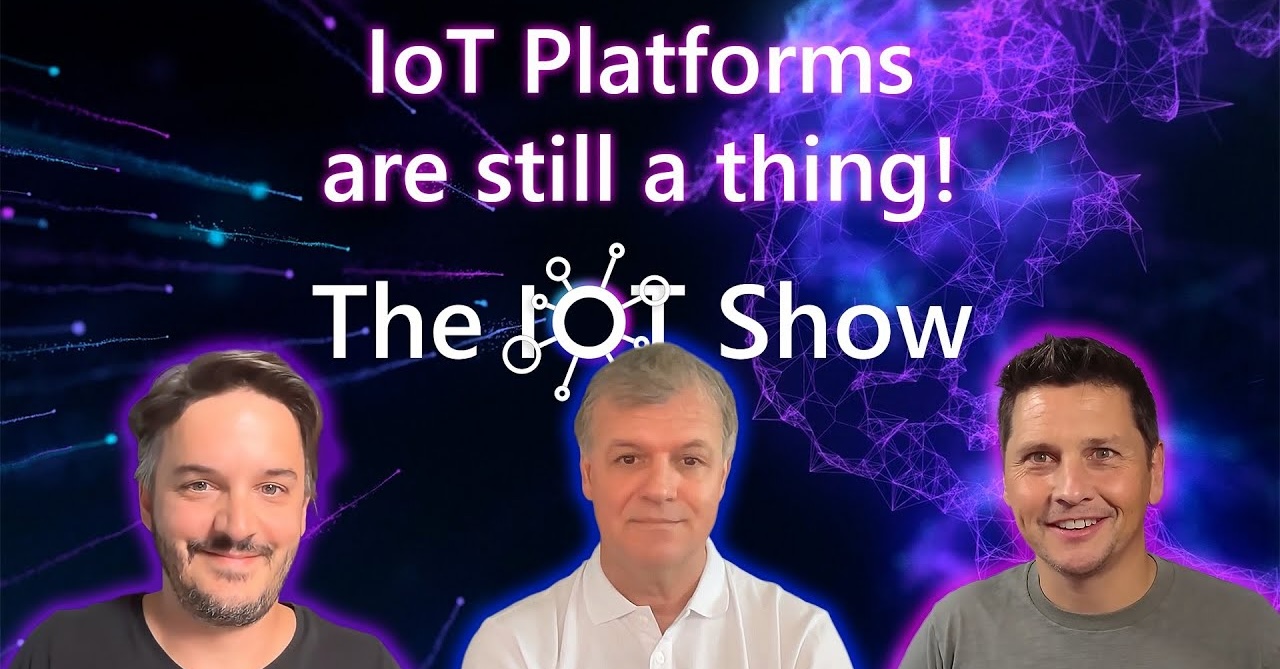
As organizations move from experimentation to scalable, data-driven operations, IoT platforms continue to play a critical role in transforming connected devices into business value. “If someone tells you that IoT platforms are no longer a thing, tell them they are wrong.”
This article is based on a recent conversation on The IoT Show, featuring Jonas Schmid (Co-Founder & CEO, Akenza) and Fabio Rosa (CEO & Founder, Tago.io). Both have spent about a decade building platforms that help customers do the part of IoT that’s still hard: turning messy, real-world sensor data into something usable, valuable, and scalable.
The podcast give a candid look at how the IoT platform market evolved, what customers actually need today, and why the “build vs buy” debate looks very different in 2026 than it did a few years ago. Here are the most important takeaways.
IoT platforms didn’t disappear — the market specialized
A recurring question in IoT is why there was never “one clear IoT platform” that dominated the space. Jonas explains: If you look back about ten years ago, there were a lot of makers building stuff, especially in LPWAN. Many early adopters were strong in hardware and field experimentation, but not necessarily in IT or enterprise deployment.
Jonas also points to a structural reality: lots of these early projects never became big enough to matter to hyperscalers: “There is still the guy that tracks a couple of rhinos in South Africa, and the other guy that tracks a few trees in Chicago.” Those kinds of projects are real, but they don’t create the standardized, massive scale that makes a single platform win everywhere.
Instead, the ecosystem matured by use case specialization; industry, buildings, agriculture, and by learning what it takes to run IoT systems beyond pilots.
Customer priorities shifted from “devices” to “data ownership”
The phrase “data ownership” comes up repeatedly. Jonas says his customers are “much more aware that they need to own the data,” and “they don’t care about the source of the data necessarily.” In other words, a sensor is only one possible input. Data might also come from a building management system (BMS) or a proprietary setup; what matters is controlling it, standardizing it, and making it compatible across environments.
He also shares a cautionary pattern from smart buildings: companies sold “black boxes of IoT,” back in the days “went bankrupt afterwards,” leaving customers with hardware they couldn’t manage. That experience has made enterprises more strategic: they want flexibility, portability, and clarity about who controls the data in the long term.
The top demand isn’t “no-code” – it’s customization without breaking processes
When asked what customers most often need, Fabio Rosa gives a direct answer: customization. For many organizations, especially mid-sized enterprises, the goal is to adopt IoT without disrupting existing processes or retraining entire teams.
Fabio Rosa highlights that IoT platforms only create value when they adapt to how companies already operate: “We want customers to get the benefit of IoT, but without forcing them to change everything they already use.”
This perspective reinforces the role of IoT platforms as long-term enablers, quietly embedding themselves into existing operations to generate the consistent, high-quality data that AI systems ultimately depend on.
The buy vs build decision is being driven by time pressure (and AI pressure)
Jonas describes a recent customer conversation: “They put down twenty FTEs for the next two years to build their own thing. We built it in three weeks. We showed them the POC after three weeks.”
That contrast captures why “buy” keeps winning in practice: companies feel competitive pressure and can’t wait years. And Jonas ties that urgency to AI: businesses want AI, but “they notice they don’t have the data for it.” His blunt summary is hard to ignore: “You need to do IoT first before you can do AI.”
Modern IoT platform decisions look less like selecting a tool and more like choosing a partner that can accelerate execution and provide the real, structured data required to train and operationalize AI models.
In that context, many organizations prefer to “hand that whole IoT topic off to someone who knows how to do it” so they can focus on AI initiatives. IoT platforms are becoming a shortcut to the data foundation AI depends on.
Watch the full episode