How Deutsche Telekom Built a Zero-Plumbing Cellular and Satellite IoT Stack
At IoT Stars, we are always looking for the partners who don't just provide a service, but enable the parts needed to turn a complex project into a working product.
That’s why we are thrilled to announce that Deutsche Telekom IoT has officially joined the IoT Stars family.
The Zero-Plumbing Cellular and Satellite IoT Stack
Sometimes the hardest devices to connect are often the ones that matter most, operating far beyond traditional cellular coverage in smart agriculture, remote utilities, or cross-border asset tracking.
If you have ever tested a Non-Terrestrial Network (NTN) satellite IoT project you know exactly where the friction lies. It is rarely the hardware itself the issue. It is usually a headache to integrate cellular-to-satellite handoffs, configuring cloud middleware, building binary payload decoders, and wiring up a dashboard that doesn't drop messages in transit, unless you work with a partner.
To prove that satellite deployment doesn’t require days of infrastructure plumbing, Deutsche Telekom, Nordic Semiconductor, and Blynk have engineered a complete, out-of-the-box hardware-to-cloud ecosystem.
And they are giving away the hardware to prove it!
Want to Test It? Giving Away 30 DevKits!
Deutsche Telekom IoT are giving away 30 Nordic nRF9151-SMA Development Kits to developers, system architects, and technical teams who want to validate live satellite tracking without writing backend plumbing from scratch.
What is inside the evaluation package:
Nordic nRF9151-SMA-DK flashed with production NTN satellite firmware and a pre-provisioned nuSIM.
Terrestrial & Satellite Connectivity: Pre-activated data allowance covering NB-IoT, LTE-M, and NB-IoT Satellite links.
D2C Middleware Access: Full access to the Deutsche Telekom Device-to-Cloud hub during the evaluation phase.
Blynk Workspace Blueprints: A ready-to-run integration path featuring pre-configured data streams, map widgets, and standard decoder scripts.
This campaign is strictly intended for technical evaluation and prototyping, not commercial deployments. Applications are open from July 7th until August 7, 2026. To ensure kits aren't shipped to regions where satellite or cellular services face localized regulatory blocks, Blynk and DT will peer-review submissions to match viable use cases.
If you are currently building a system that needs to operate reliably where there is zero terrestrial signal, bypass the integration headaches.
The Stack
This unified architecture delivers an end-to-end telemetry loop from a physical device to a web or mobile dashboard in less thn 20 seconds.
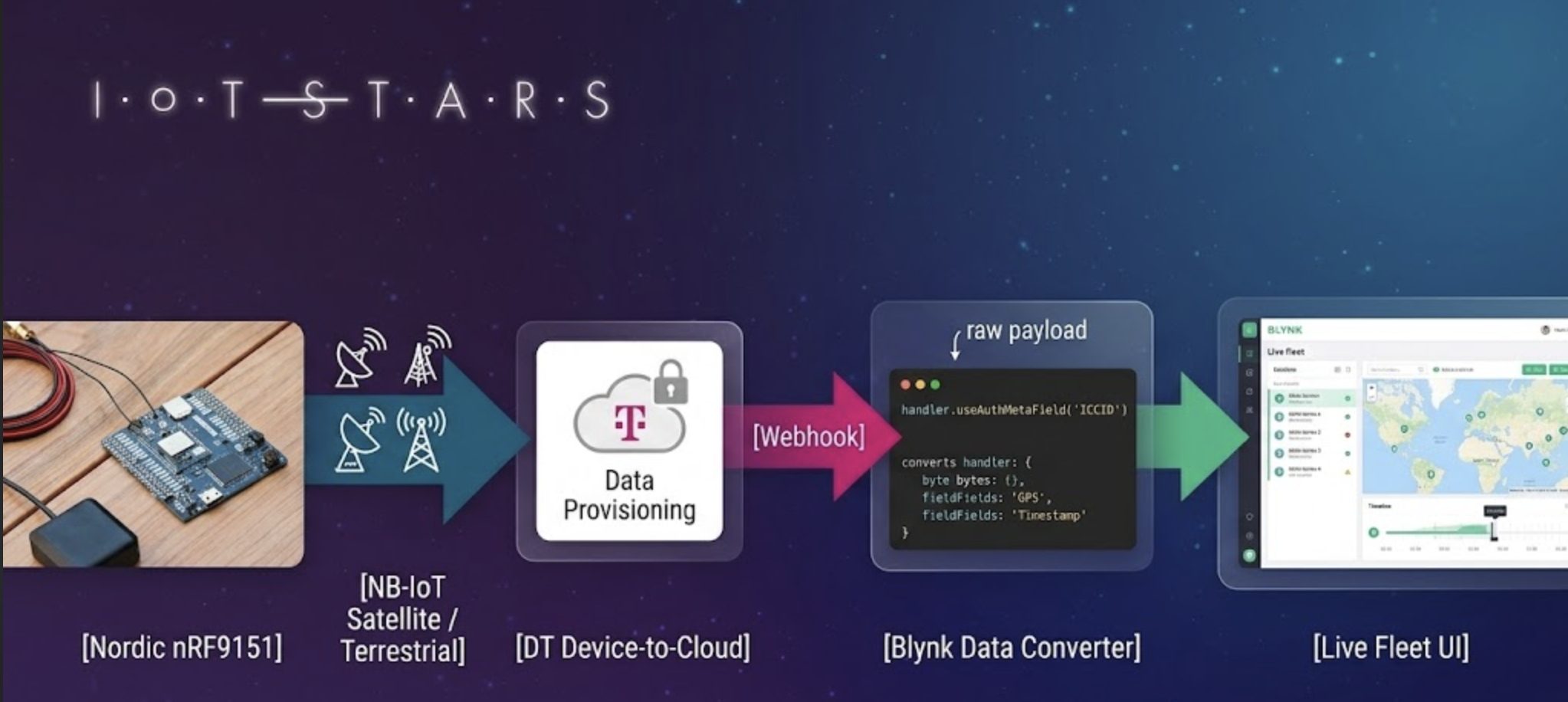
The Hardware: Nordic nRF9151
The heart of the edge layer is the nRF9151 SiP, running production-ready NTN modem firmware. To guarantee reliability, the system demands a dual-antenna configuration: an external NTN-capable antenna (operating across 2 GHz S and L bands) and a dedicated GNSS antenna.
Why GNSS (GPS)? Because the device requires an exact satellite timing-advance offset calculation before it is even permitted to attempt an uplink registration.
The Network: Deutsche Telekom IoT
Terrestrial LTE-M and NB-IoT handle the terrestrial connectivity layer, but the moment cellular coverage drops, the system seamlessly routes payloads across DT's network of over 600 certified roaming and satellite partners.
Micro-payload efficiency is achieved using secure UDP routing via pre-activated nuSIM components, billing data in highly optimized 1-byte blocks to trim over-the-air overhead.
The Middleware: DT Device-to-Cloud (D2C)
Raw UDP streams hitting the satellite constellation are instantly ingested by DT's Device-to-Cloud (D2C) platform. Acting as a lightweight protocol adapter, D2C manages device authentication via structural IMEI mapping and pipes the payload forward via high-speed webhooks.
The Platform: Blynk Data Converter
On the receiving end, the Blynk Data Converter pipeline picks up the raw bytes from the Deutsche Telekom IoT D2C webhook. A cloud-side JavaScript engine parses the incoming byte array, extracts the metadata, and relies on an internal function. Find more information here.
By mapping the incoming SIM card's unique ICCID directly against device metadata fields, a single endpoint dynamically routes traffic across an entire fleet of diverse edge targets, instantly spinning up live map trackers, data timelines, and native mobile interfaces.
Connecting devices beyond cellular coverage shouldn't mean dealing with integration issues. Discover how Deutsche Telekom, Nordic Semiconductor, and Blynk built an out-of-the-box, hybrid terrestrial-satellite stack that routes data to live dashboards in under 20 seconds and how your team can apply to get one of 30 free nRF9151 dev kits to test it yourself.