The SGP.32 Reality Check
The message is consistent: a new era of flexibility where the power to choose (and switch) providers is finally in the hands of the customer. On paper, every new IoT application hitting the market today should be built on this standard.
But are they? The initial specifications were released in May 2023 by the GSMA, and the final version has been stable since June 2024. That’s plenty of time to see SGP.32-ready devices flooding the market, but where are these devices? Why don’t we see them everywhere yet? Is something still holding the industry back?
Let’s unravel the SGP.32 story and find out if the standard is truly production-ready.
SGP.32 Explained
To understand the obsession, we have to look at how we got here. Consumer eSIMs are already a reality; the latest US iPhones don’t even have a physical SIM slot. For a human, scanning a QR code to download a profile is a quick and seamless process.
But IoT devices are different. They are often resource-constrained, "headless" (no screen or camera), come in high volumes, and need to be managed via the cloud. The consumer standard (SGP.22) simply didn't fit these requirements. This led to the birth of SGP.32, featuring an architecture redesigned around three core elements:
The Device: Running the IPA (IoT Profile Assistant) which resides inside the SIM (IPAe), or inside the device (IPAd).
The Orchestrator: The eIM (eSIM IoT Remote Manager), a cloud component which directly communicates with the IPAs.
The SIM database: The SM-DP+ (Subscription Manager Data Preparation Plus), the server where the actual SIM profiles live.
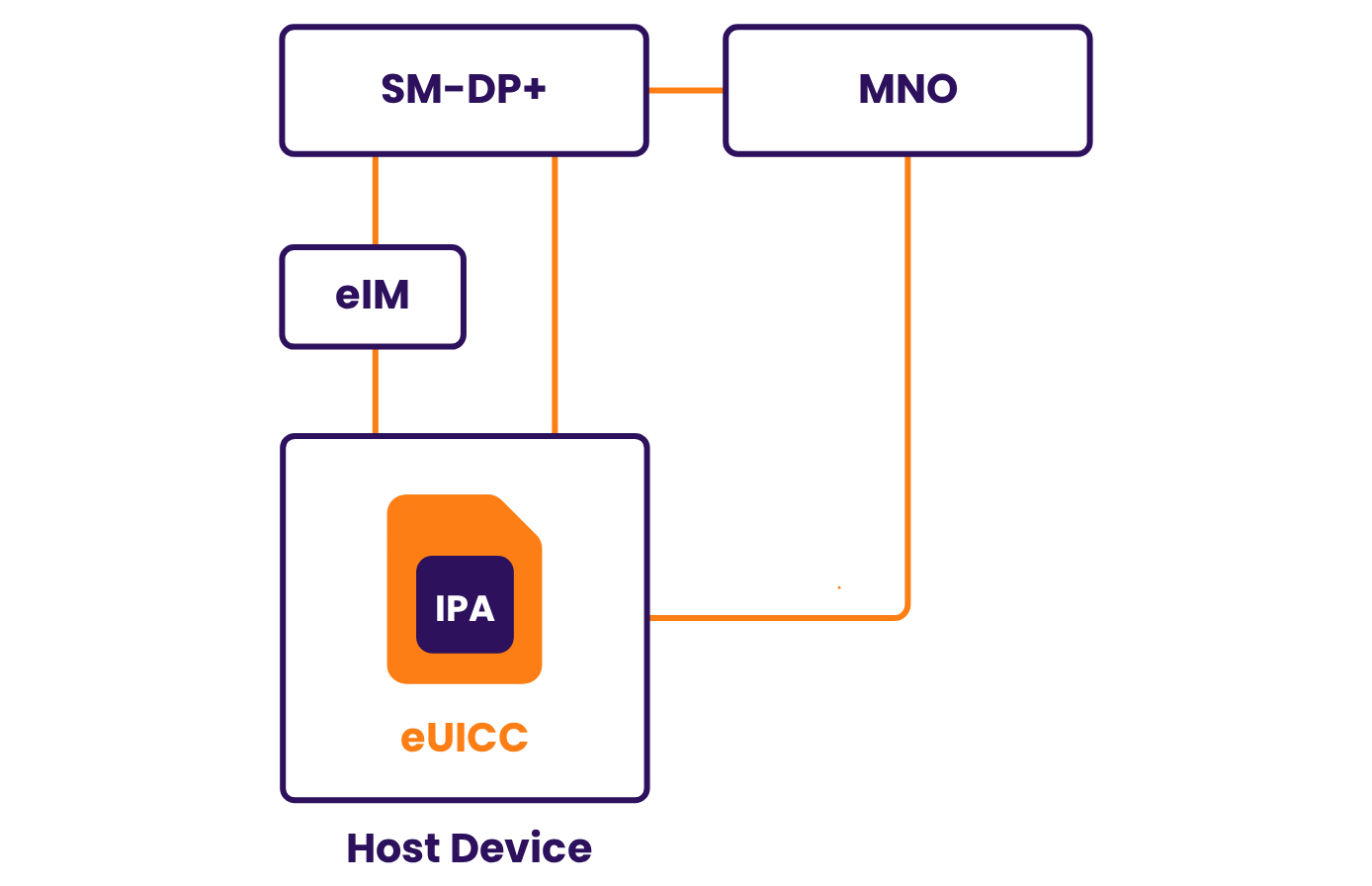
SGP.32 architecture (simplified)
In essence, the IPA on the device "checks in" with one or multiple eIMs at configurable intervals to see if there are any pending instructions, like download, activate, delete or disable a SIM profile. If a download is pending, the device pulls the new profile from the SM-DP+ and, once enabled, switches connectivity without any physical intervention. Simple, right? But does it actually work in a messy, multi-vendor environment?
Kigen is proud to be involved in the tests done by IoT Stars to showcase that the SGP.32 technology is mature. It delivers a true freedom and distinction between the hardware choices (plastic or soldered, eSIM form factor, grade) and the digital profiles which can be loaded on the eSIM and enabling the required connectivity or features offered by the various connectivity providers. Kigen stands ready to help the IoT devices makers of tomorrow with a wide ecosystem (notably with our Secure with Kigen module partners).
– Loic Bonvarlet SVP Ecosystem & Marketing, Kigen
Putting SGP.32 to the Test
Beyond the PR and the slide decks, we wanted to validate if SGP.32 was ready for the rigors of production. We teamed up with several partners to put their SGP.32 readiness to the test, including Kigen (eSIM and eIM provider) and the connectivity providers: ZARIOT, Soracom, and Onomondo.
Five different plastic SIMs with eUICC profiles were used, each containing an IPAe connected to Kigen’s eIM. The SIMs were attached to five different host devices:
Nordic Semiconductors’ nRF9151DK
DPTechnic’s Walter with Sequans Monarch 2
SG Wireless’ F1 Kit with the F1 Smart Module
Murata Type 1SC EVK2
Actinius Icarus with the nRF9160
The test was conducted to validate whether the SIMs would migrate between three different connectivity providers in real-time.
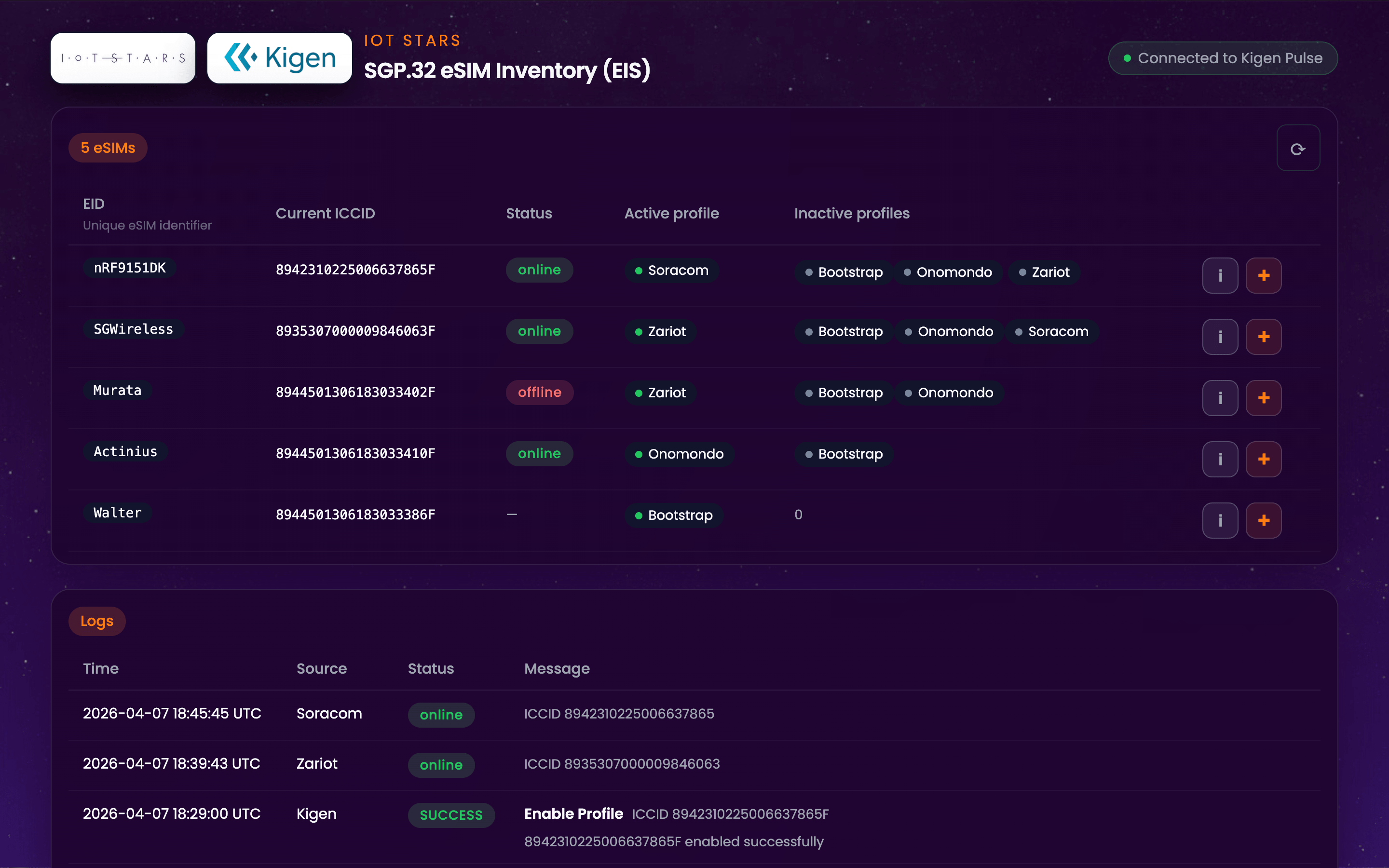
IoT Stars SGP.32 test environment with the integrated APIs of Kigen, Soracom, Onomondo and ZARIOT
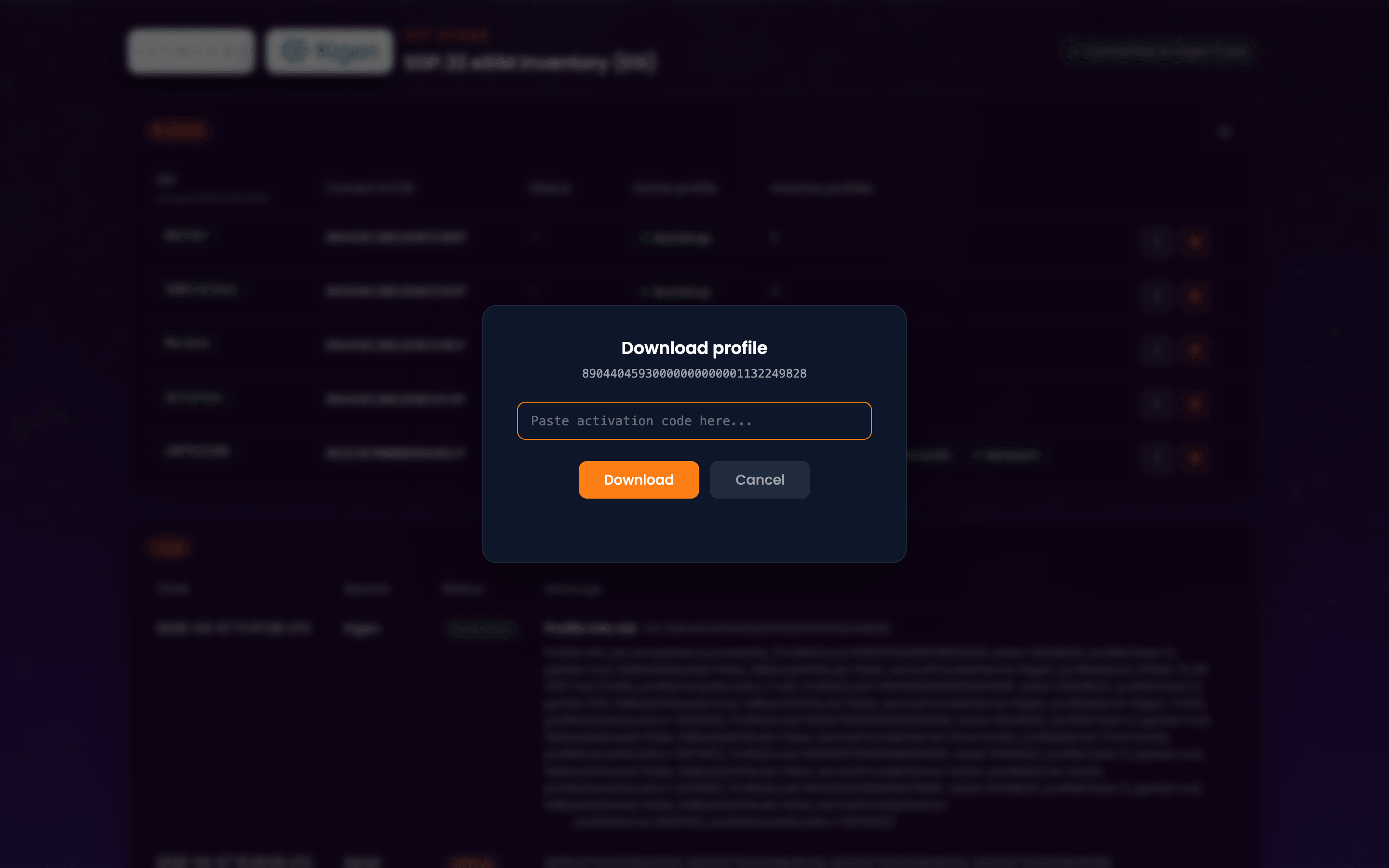
Adding a new profile to a SIM by initiating the "Download" operation
Soracom has always believed that dependence on a single connectivity provider only limits IoT deployments, and SGP.32 holds the promise to remove that limit at last. Independent, multi-vendor validation like the testing IoT Stars organized confirms the standard delivers in real-world conditions. That's why we built our Connectivity Hypervisor to enable profile orchestration with SGP.32 at the foundation.
— Kenta Yasukawa, CTO and Co-Founder, Soracom
The Verdict: The Standard Works.
The results? The SGP.32 standard is ready for mass adoption by the industry. The tests demonstrate that the ecosystem has successfully moved past the "lab experiment" phase as devices could migrate between vendors seamlessly. As the SGP.32 standard proved to work in a real-world setting, enterprises can start embedding the remote SIM provisioning standard into their next-generation applications.
Tests like this are exactly what the industry needs right now. The whole SGP.32 standard and promise of Remote SIM Provisioning only works when it's implemented correctly, and the more we can prove that in real multi-vendor environments, the easier it becomes for companies to actually make the decision to build on it. Adoption accelerates when there's trust backed by evidence and not just promises.
– Henrik Aagaard, CTO & Co-founder, Onomondo
Join the live demo!
Let’s move beyond another article claiming an "eSIM revolution" and look at how it works in real life.
Join the live webinar on April 28, 4pm CEST / 7am PST to watch SGP.32 in action. We won’t just show the technology; we’ll discuss the real-world implications, including the impact on power management and battery life.
The demo includes downloading a profile onto a live SIM and reconfiguring an entire fleet remotely. See it for yourself and decide if you're ready to make the switch.
It’s great to be involved in this independent real-world demo and prove SGP.32 works in the wild. We would encourage IoT manufacturers, integrators and solution owners to give it a try, and feel free to take advantage of ZARIOT high-touch technical support program for early adopters. Our engineers can quickly help you address any teething problems and allow you to experience the advantages that SGP.32’s flexibility brings at the earliest opportunity.
– Justin Alcorn CCO, ZARIOT
by Laurens Slats
laurens@iotstars.com