We don’t need more devkits, we need to make the economics of hardware development work
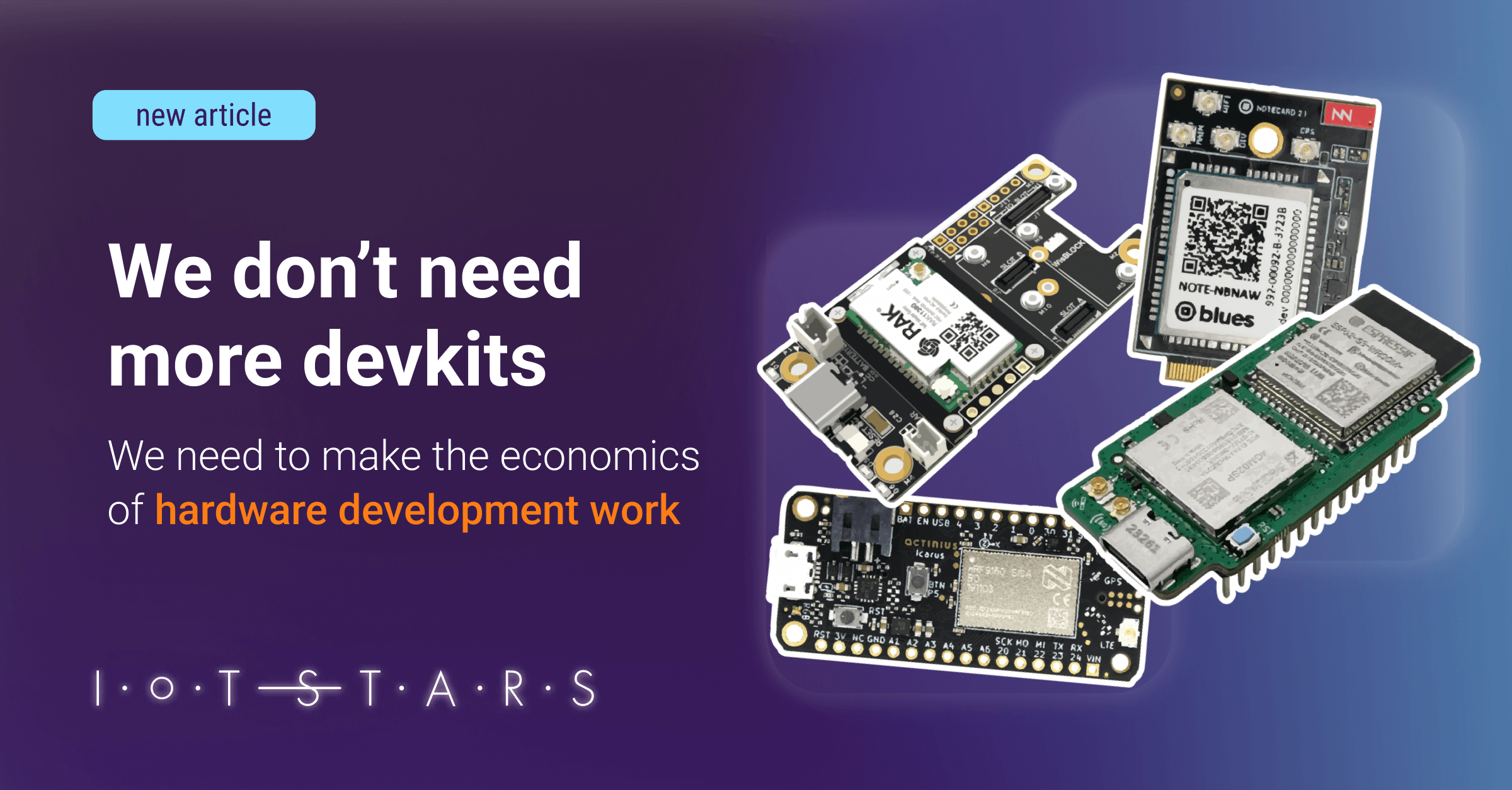
I don’t need more Dev Kits. My house is piling out with STM boards, Nordic dev kits, Arduinos (both green and black), ESP32s, Raspberry Pis, and plenty of LoRaWAN development boards I don’t even remember ordering.
Prototyping has never been easier with the pletoria of available devkits, free developer accounts, and publicly available documentation. Then why don’t we focus on the real challenge of turning these prototypes into real-world products? This remains one of the most painful parts of building connected products. According to SG Wireless, which supports companies in scaling their IoT projects, 83% of IoT projects fail “because they can’t handle real-world complexity.”
One of the biggest complexities is crossing the gap between a POC and a scalable product.
Why do we keep starting from scratch?
“I think embedded development has a bad habit of wanting to build everything from scratch. And that is proven to be a pretty difficult approach” as stated by Joe Schneider during the latest IoT Stars show in Anaheim.
It’s a pretty difficult approach I can say, having to figure out the processes around firmware updates, secure boot, or general low-power performances blocks me from turning my many projects into a real-world product.
The tooling ecosystem doesn’t help either. Embedded development remains heavily vendor-locked. Developers are nudged into STM32Cube or Microchip’s MPLAB, and each ecosystem comes with its own SDKs, HALs and build systems. Firmware written for one chipset doesn't transfer to another. Switching hardware usually means rebuilding your codebase from the ground up.
Then there’s the hardware development process. From PCB design, to RF optimization, certification, to manufacturing. The upfront investment easily reaches 6+ months and hundreds of thousands of USDs.
No wonder so many projects die along the way.
The Rise of Software-Defined Everything
Slowly but steadily a shift is happening, though. In a previous article, The Reprogrammable Machine, I questioned the industry’s fixation on hardware. Success in IoT rarely depends on the hardware itself; it depends on the software that powers it. The market is slowly waking up to that idea, and you can see it in the momentum behind Real-Time Operating Systems (RTOSs) like FreeRTOS or Zephyr, but also on Atym’s platform which is primarily based on the WebAssembly/Wasm to make binaries portable from one platform to the other.
For the industry to scale, we need hardware that behaves more like software: flexible, reusable, extensible, and not tied to a single vendor’s ecosystem. That means treating the hardware not as a static asset, but as a platform layer on which software sits.
This is where semi off-the-shelf hardware comes in.
What Semi Off-the-Shelf Hardware Actually Means
Semi off-the-shelf hardware is not yet another dev kit. And it’s not a fully custom board that kills your business case either.
It’s the middle ground we’ve been missing: a field-ready hardware foundation that works for prototyping and production.
It’s small and power-efficient enough to deploy in hundreds of early devices without redesigning anything. It’s open, both in terms of hardware and software, in a way your team can build upon it.
This kind of hardware lets prototypes grow into products, instead of being discarded the moment they work and having to start all over to build the production-ready product.
Examples of Hardware Moving in This Direction
A few companies are already leaning into this idea.
The Walter module from DPTechnics is a good example. It is fully open-source, both hardware and software and supports a wide variety of development environments, including Zephyr, ESP-IDF, MicroPython, and Arduino. The size is production-ready; the power profile works both on the bench and in the field. You can build a prototype on Walter and then deploy the same module in the real-world without restarting the entire engineering process. Packed with multiple radios (LTE-M, NB-IoT, WiFi, BLE and GNSS) and certifications, the end-product certification efforts and costs are also minimized.
Others are operating with similar principles.
Actinius builds Nordic-based products designed to be cost-effective, pre-certified and low-power.
Blues offers the Notecard: a cellular module that’s meant to be used directly in products, not just prototypes.
RAK Wireless provides lego-like Wisblocks which can be industrialized in a later stage.
These companies aren’t selling dev kits, they’re offering foundations for developers to build upon.
Where the Industry Needs To Go Next
A healthy IoT ecosystem should look more like the modern software world, with hardware-agnostic firmware, development environments that don’t lock you in, tools for easy scaling, and a more collaborative mindset where work is openly shared.
The real antidote to the 83% failure rate isn’t more devkits. It’s making the economics of hardware development work by closing the POC-to-Production gap.
I am eager to hear your thoughts.
Written by Laurens Slats